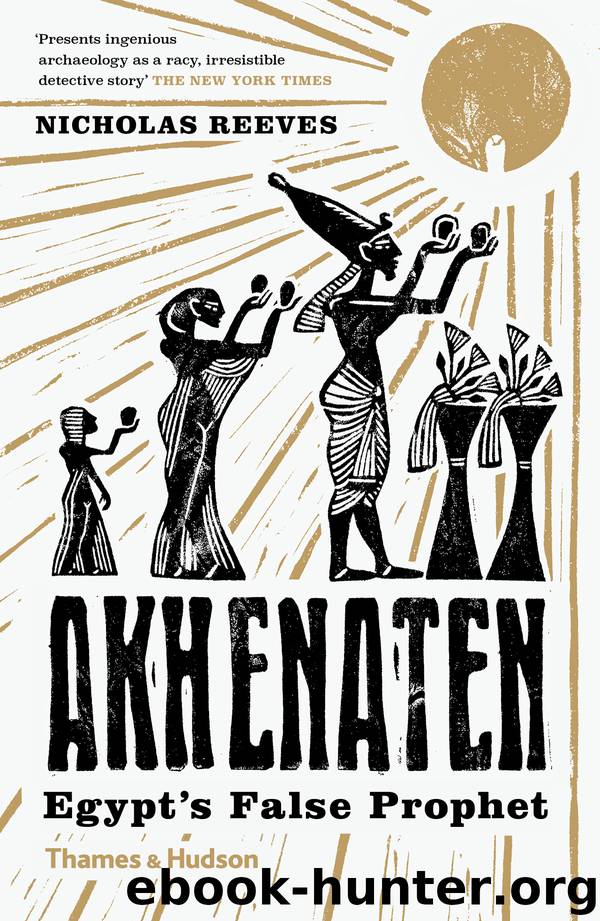
Akhenaten by Nicholas Reeves
Author:Nicholas Reeves
Language: eng
Format: epub
Publisher: Thames and Hudson Ltd
Published: 2019-10-10T16:00:00+00:00
‘Re, horizon ruler, who rejoices on the horizon in his name of Re the father, who has returned as the sun disc.’
Akhenaten’s construction programme has been studied in detail by Egypt Exploration Society architect Michael Mallinson. It evidently began with the erection of the two boundary stelae M and X, one to the north and one to the south, the mid-point between these serving to define the central axis of the city. On this axis, Akhenaten erected the first altar, initially a simple sacred grove (the future Small Aten Temple), with a small palace (the King’s House) to its northern side; at the termination of the axis – at the same distance east–west as the stelae are north–south – he would establish his tomb. A second temple erected to the north (the future Great Aten Temple) and two other important palace complexes to the north (the North Palace) and south (the South Palace) seem to have been positioned with reference to key distances along the processional routes at Thebes (Karnak–temple of Mut; Karnak–Luxor).
In the second discernible stage of development at el-Amarna, the first simple shrines were replaced with stone sanctuaries bounded by enclosure walls, their form based on the small stone temples of Amenophis III at Karnak, but open to the sky in the manner of the Heliopolitan sun temples. Again, certain correlations in the dimensions of the el-Amarna structures and earlier building-works at Karnak and at Heliopolis have been recognized by Mallinson. The conclusion which has suggested itself to him is that Akhetaten’s two principal temples were in fact symbolic substitutes for the two main Re shrines at Heliopolis and Karnak – those of Re-Horakhty and Amun-Re. For Mallinson, the king’s aim was evidently for the new capital to unite the essence of the two cult centres within a single ambit.
The final stage in setting out the city saw the symbolic nature of the structure extended and clarified, with 12 more stelae erected to establish the final boundaries across the Nile river and into the desert. Now, for the first time, we begin to discern the amazing rationale behind the kingly scheme. By joining up the dots, so to speak, Mallinson has been able to show that the proportions of the Great Aten Temple, when projected out, replicate those of the city limits – revealing the hidden truth that the entire foundation had in fact been conceived as one vast temple. What is more intriguing still, however, is the focus of this ‘temple’: the Amarna royal tomb, located beyond the break in the eastern cliffs through which the Aten was reborn each day.
In this light, Akhenaten’s vow not to extend beyond the limits set by the boundary stelae becomes easier for us to understand, as does his stated desire that, wherever he die, he be interred within the royal tomb. With the royal tomb as the raison d’être of Akhenaten’s architectural scheme, our newly discerned basis of Amarna religion – the kingship itself – finds extraordinary confirmation. In this
Download
This site does not store any files on its server. We only index and link to content provided by other sites. Please contact the content providers to delete copyright contents if any and email us, we'll remove relevant links or contents immediately.
| Africa | Asia |
| Canadian | Europe |
| Holocaust | Latin America |
| Middle East | United States |
Fanny Burney by Claire Harman(26603)
Empire of the Sikhs by Patwant Singh(23086)
Out of India by Michael Foss(16853)
Leonardo da Vinci by Walter Isaacson(13336)
Small Great Things by Jodi Picoult(7143)
The Six Wives Of Henry VIII (WOMEN IN HISTORY) by Fraser Antonia(5515)
The Wind in My Hair by Masih Alinejad(5095)
A Higher Loyalty: Truth, Lies, and Leadership by James Comey(4964)
The Crown by Robert Lacey(4817)
The Lonely City by Olivia Laing(4802)
Millionaire: The Philanderer, Gambler, and Duelist Who Invented Modern Finance by Janet Gleeson(4478)
The Iron Duke by The Iron Duke(4356)
Papillon (English) by Henri Charrière(4274)
Sticky Fingers by Joe Hagan(4199)
Joan of Arc by Mary Gordon(4113)
Alive: The Story of the Andes Survivors by Piers Paul Read(4033)
Stalin by Stephen Kotkin(3968)
Aleister Crowley: The Biography by Tobias Churton(3640)
Ants Among Elephants by Sujatha Gidla(3467)
